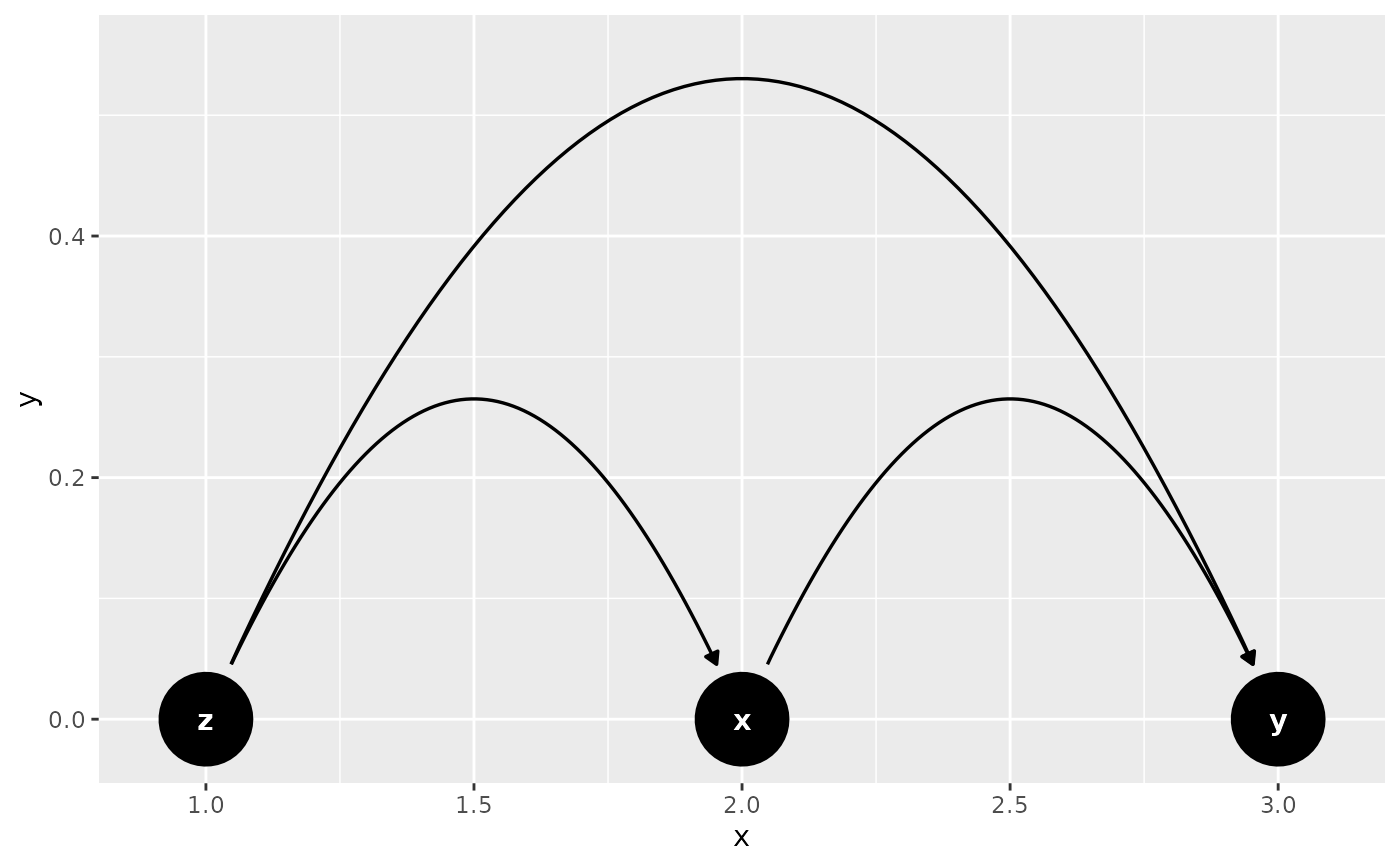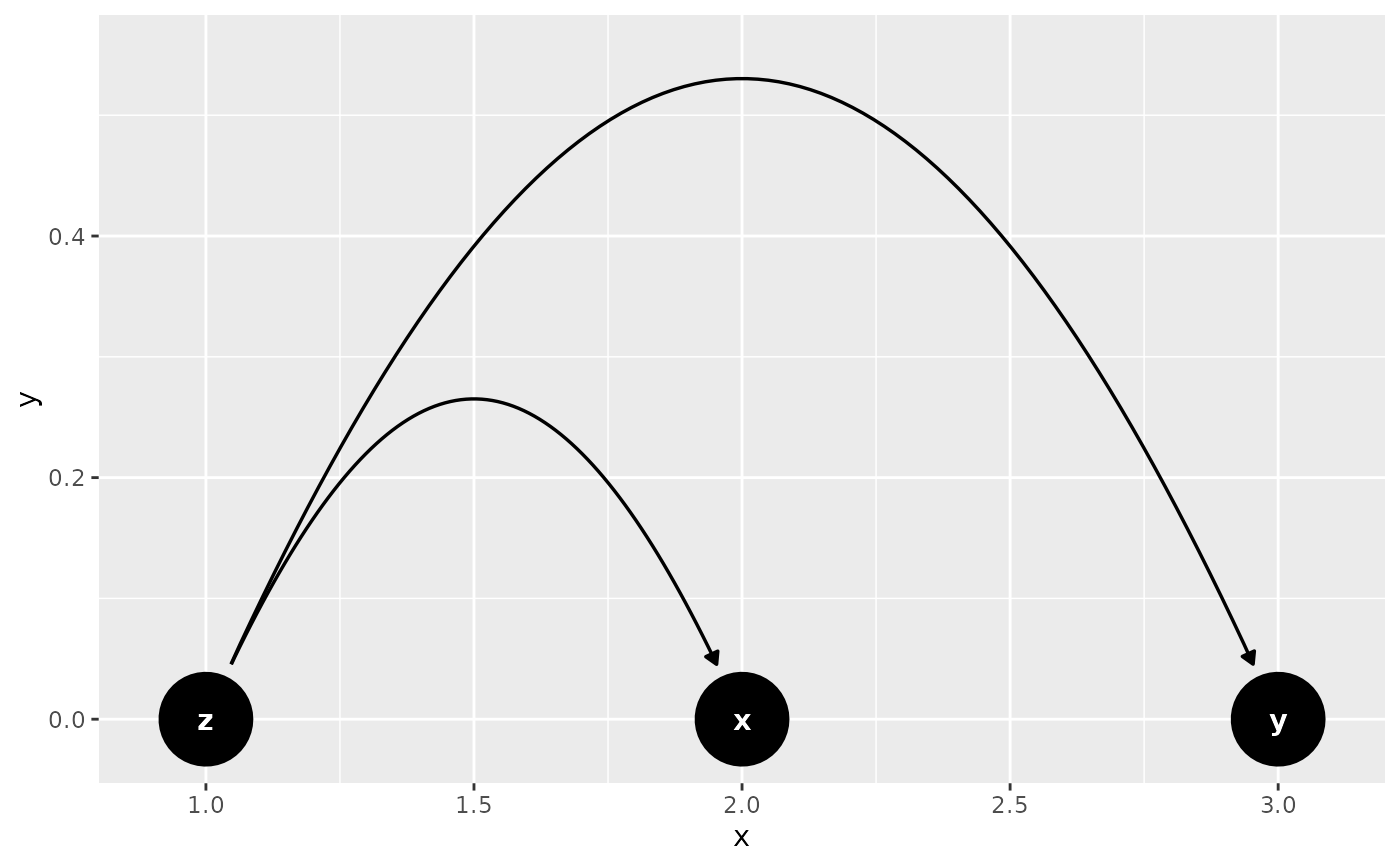
dag_saturate() takes a tidy DAG object and, optionally using existing
coordinates, saturates the DAG based on time ordering of the nodes. To create
a saturated DAG from scratch, see as_tidy_dagitty.list(). dag_prune()
takes an existing DAG and removes edges. This is most useful when used
together with saturated DAG.
Usage
dag_saturate(
  .tdy_dag,
  use_existing_coords = FALSE,
  layout = "time_ordered",
  seed = NULL,
  ...
)

dag_prune(.tdy_dag, edges)
Arguments
- .tdy_dag
A
tidy_dagittyordagittyobject- use_existing_coords
Logical, indicating whether to use existing node coordinates.
- layout
a layout available in
ggraph. Seeggraph::create_layout()for details. Alternatively,"time_ordered"will usetime_ordered_coords()to algorithmically sort the graph by time. You can also pass the result oftime_ordered_coords()directly: either the function returned when called with no arguments, or the coordinate tibble returned when called with arguments.- seed
a numeric seed for reproducible layout generation
- ...
optional arguments passed to
ggraph::create_layout()- edges
The edges to remove, in either of two forms. A named character vector where the name is the starting node and the value is the end node, e.g.
c("x" = "y")removes the edge going fromxtoy. Or a data frame with anameand atocolumn, which says the same thing, and an optionaldirectioncolumn of"->","<->", or"--", which names one of the edges a pair of nodes holds.
Details
Bidirected edges carry no time-ordering information, so dag_saturate()
assigns time order from the directed edges alone and then passes the input's
bidirected edges through to the saturated DAG unchanged. A saturated model
therefore never implies an independence that the input denies.
dag_prune() errors if edges is empty, and if it names an edge the DAG
does not contain, including an edge written in the reverse direction. A node
whose every edge is pruned is kept as an isolated node.
A pair of nodes can hold a directed edge and a bidirected edge at the same
time, and endpoints alone name both of them. dag_prune() errors on such a
pair rather than pruning both; name the direction as well, with the data
frame form of edges, to prune one of them.